
From Linkage to Evidence: A More Integrated Approach to RWE
Recent announcements across the life sciences industry, including new patient-anchored data initiatives, have brought attention to an important question: when companies invest in real-world data (RWD), what actually turns that data into decision-grade evidence?
Most of the industry agrees on a core methodological principle in real-world evidence (RWE) generation: patient-level linkage is a foundational capability, and it’s most valuable when paired with fit-for-purpose data sources, study design, endpoint validation, and targeted enrichment. Whether a linked dataset can reliably answer a given research question still depends on data relevance, completeness, and validity—particularly with respect to endpoint capture, longitudinal follow-up, and cohort definition 1. Where perspectives begin to diverge is in how the industry interprets and responds to this challenge.
Linkage is foundational infrastructure
Tokenization is sometimes judged in the context of downstream evidence quality, but its primary role is more specific and more foundational; that is, enabling privacy-preserving patient-level connectivity across datasets. That connectivity is essential in a healthcare system where patient journeys are fragmented across providers, sites of care, and data systems.
The usability of real-world evidence depends on how that connectivity is applied. Factors like data relevance, source coverage, endpoint capture, longitudinal follow-up, and cohort definition all play important roles in determining whether a dataset is fit for a specific research question.
This distinction matters. Linkage answers the question: Can we connect patient records securely and accurately across sources? Fit-for-purpose evidence strategy answers a different question: Does the connected data contain the clinical detail, completeness, and validity needed for the intended use case?
When additional data depth is needed, linkage can help identify where those gaps exist and guide the targeted use of record retrieval, unstructured data, registry data, or patient-mediated collection. Linkage does not compete with other evidence-generation approaches. It provides the connectivity layer that helps make them more precise and effective.
Access is not the same as comprehensive retrieval
Linkage enables access to data across sources, but for certain research questions, teams may also need additional clinical detail, source-level documentation, or endpoint-specific validation to support the intended use case.
In practice, many clinically relevant endpoints remain embedded in unstructured records, fragmented across sites, or absent from commercially-available datasets. For research questions requiring additional clinical nuance or source-level validation, linked data assets can be strengthened through targeted retrieval and enrichment.
This is where retrieval becomes critical.
Record retrieval extends the value of linked RWD by enabling targeted collection of primary source documentation—medical records, clinical notes, and other source materials—directly from the sites of care. This allows organizations to:
- Support validation of endpoints that may not be fully captured in structured data
- Fill gaps in longitudinal patient histories
- Access clinically rich detail required for complex study designs
Importantly, retrieval is most effective when applied selectively, not as a replacement for network-scale data. Linkage provides the breadth to identify relevant populations and characterize data coverage; retrieval provides the depth to close specific evidence gaps.
Together, they form a complementary model: connectivity to understand what data exists, and targeted retrieval to ensure that critical information is complete, traceable, and fit-for-purpose.
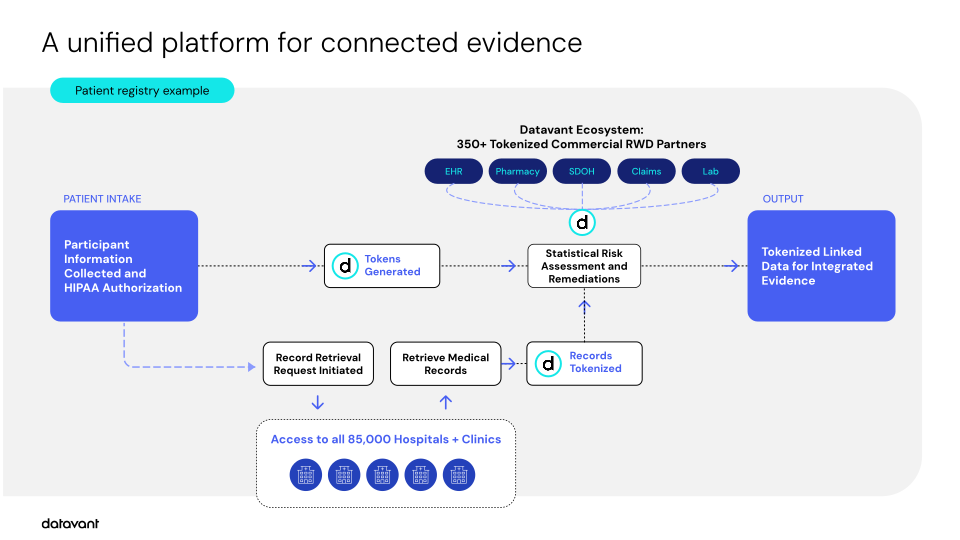
Figure 1: Example workflow combining patient intake, tokenization, cross-dataset linkage, and targeted record retrieval to generate an integrated dataset for analysis.
Patient-anchored models add depth—but introduce tradeoffs
PicnicHealth’s ThumbPrint reflects a patient-anchored, consent-driven approach to data generation. This model has strengths. Direct patient engagement can support deep phenotyping, enable prospective data collection, and reduce loss to follow-up in specific contexts. These capabilities may matter in settings such as rare disease research or studies requiring novel endpoint capture.
Every data generation model carries structural tradeoffs that must be considered:
- Scale and representativeness are constrained by recruitment and consent dynamics
- Ongoing patient engagement can add significant operational complexity
- Coverage of the broader care ecosystem is limited to enrolled populations
These are design choices rather than shortcomings. Patient-mediated data collection optimizes for depth and control, while network-scale linkage contributes breadth, representativeness, and visibility across care settings.
Network-scale linkage enables representativeness and optionality
RWE used for regulatory and commercial decision-making increasingly must be representative of real-world populations, longitudinal across care settings, and adaptable as new questions emerge.
These characteristics depend on network-scale data connectivity underpinned by advanced identity resolution capabilities strong enough to enable high-confidence matching across datasets, even when patient identifiers are incomplete, inconsistent, or changing.
Privacy-preserving linkage infrastructure enables:
- Retrospective analysis across millions of patients without re-recruitment
- Integration of heterogeneous data sources not originally designed to interoperate, with high-confidence patient matching across those sources
- Reuse of connected data assets as evidence needs evolve
- Continuous refresh as underlying datasets are updated over time
This is where linkage creates durable strategic value: not as a point solution but as a persistent layer of connectivity that supports multiple evidence use cases across the clinical development and commercial lifecycle.
Importantly, this connectivity also makes patient-centric approaches sharper. Identifying where deeper data collection is required, and for which patients, starts with understanding the broader population through linked data.
Advancing RWE requires integration, not substitution
The strongest strategies do not pick between tokenization and patient engagement. They combine secure, privacy-preserving linkage for scale, fit-for-purpose data evaluation tied to the research question, and targeted, consent-based collection for depth where it is needed.
The industry is moving toward integrated architectures that combine these capabilities in practice:
- Secure, privacy-preserving linkage for scale and representativeness
- Fit-for-purpose data evaluation aligned to specific research questions and endpoints
- Targeted, consent-based data collection for depth where needed
In practice, this integrated model is already being applied in complex real-world studies. For example, in a recent natural history study in a rare disease, Datavant researchers combined network-scale linkage across electronic health records and specialized registry data to construct a longitudinal cohort that would not have been feasible through prospective recruitment or record retrieval alone.
Linkage enabled identification of a cohort of approximately 1,300 patients across care settings—including those captured in transplant registries—while the incorporation of unstructured clinical data supported the capture of nuanced clinical endpoints such as disease progression and major interventions.
This approach enabled longitudinal follow-up across fragmented care journeys, with patient timelines spanning several years of clinical history, illustrating how scale, data diversity, and fit-for-purpose design must come together to support rigorous evidence generation.
Within this model, linkage helps determine where patient engagement, retrieval, or additional enrichment can be applied most effectively.
What this means for evidence strategy
The implication for life sciences organizations is to continue treating linkage as foundational, while pairing it with rigorous fit-for-purpose planning.
This includes:
- Evaluating data sources against endpoint requirements early in study design
- Assessing linkage feasibility, source coverage, and anticipated evidence gaps before execution
- Designing evidence strategies that integrate both retrospective connectivity and prospective data collection where appropriate
Organizations that get this right are not choosing between models. They are building evidence architectures that preserve optionality, maintain representativeness, and meet increasing expectations for scientific rigor from regulators, payers, and clinical stakeholders.
The bottom line
Tokenization remains foundational to privacy-preserving linkage. Its greatest value comes when it is embedded within a broader evidence strategy that also accounts for data relevance, endpoint completeness, clinical context, and fit-for-purpose validation.
The future of RWE is not about choosing one model over another. It is about building coherent, scientifically grounded evidence strategies that combine secure linkage, fit-for-purpose data evaluation, targeted enrichment, and clinical validation where needed.
If you are evaluating how to structure your RWD and RWE strategy to ensure both scale and depth, we welcome the opportunity to discuss how Datavant can support your approach. Connect with our team here.
1 ISPOR. Real-World Evidence: From Frameworks to Practice.; Duke-Margolis Center for Health Policy. A Roadmap for Developing Study Endpoints in Real-World Settings.


